
What is it like to move from Sydney and start a Drupal community across the world in a city in Peru? We started with just two members and now we are just starting to build an ecosystem where people are getting trained and finding work in Drupal.
I moved from Sydney to Peru three years ago to work with a Christian mission. I used to work as Drupal developer in a bank in Sydney before my move and I’ve been fortunate to get to know several of you in the Sydney Drupal community.
Getting Started
As soon as I got to Peru I looked up the local Drupal group. There was an active community in the capital Lima and some other cities but not mine. I was in Peru’s second largest city - a beautiful city called Arequipa (pronounced AR-RE-KEE-PA). I posted in Peru Drupal groups to see if anyone wanted to meet up. I had a lot of encouragement from the community and more importantly there were a couple of people who wanted to meet me. The first meetup was just two of us, a local Drupal developer called Carlos Tamayo and myself.
Failures
I quickly realised that we needed to train new developers. There were no companies or organizations training new people. My primary job with the mission was to work with the Christian student movement. Through this I met lots of students and naturally some of the Comp Sci students were interested in learning Drupal. So in my spare time I began teaching one student. After a couple of months he got a part-time job and no longer had time. I started from again with another student and again in a couple of months he began a part-time course and had to drop learning Drupal. I realised that this wasn’t going to work. For both these students Drupal was something to do on the side and had little value. As a teacher, I too was learning how to teach. My mistake was I didn't inspire the passion and didn't show them the value of Drupal. They didn’t have a vision of what they could do with Drupal and they dropped Drupal as soon as some other option was available.
I had a long chat with Fernando Paredes (@develCuy) who founded the community in Peru. He lived in the capital Lima and had a lot of community building experience. We formed a plan. The training process needed to benefit me as well as help students ultimately find Drupal work. Through the mission I found some simple projects I could build with Drupal that would provide students with real experience. At the end of the course we would see if we could offer the best students Internships. I knew several Drupal employers in other cities.
Small Successes
I spoke to the director of Systems Engineering at the university and offered to teach a course in Drupal at the university. It was going to be a free course and I would volunteer my time. I wanted a small handpicked class of students who were absolutely committed. It began with a presentation at the university to about 45 interested students. I gave a quick introduction to Drupal and spoke about the value of learning Drupal. 32 students gave me their names and were interested in signing up for the class. I emailed them an exam and 15 responded. Fernando and I interviewed 12 students and we selected 8 students. 2 students had a clash in their timetable. So finally we had a class of just 6 students - which was perfect. We studied Drupal 4 hours a week for 12 weeks. With a groups of students who understood the basics were able to take on several little projects.
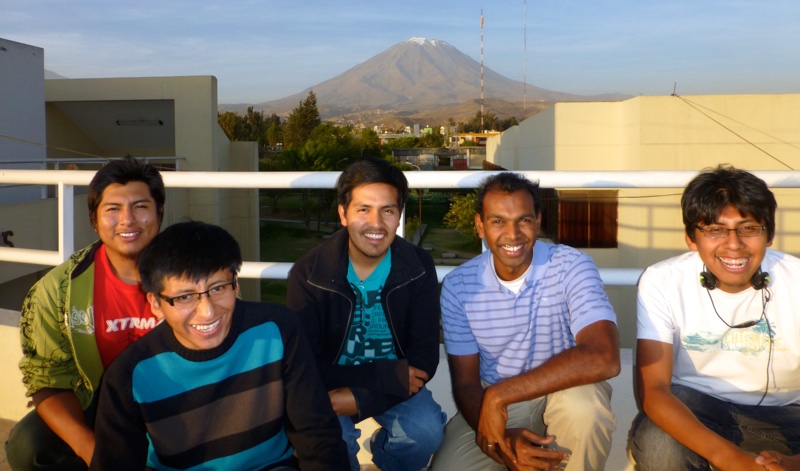
Students from our first class
I’m now about to do this for the third time and I’m pleased to say that we are slowly building a Drupal ecosystem. We've run a hackathon. I’ve taken groups of students to Drupal Camps which have taken place in other cities, sometimes paying for students who couldn’t afford the trip. Now several students have had the opportunity of working on commercial Drupal projects and slowly more will find work in Drupal.
Other helpful factors
Things are getting easier at the university with a change in the curriculum that includes subjects on web programming. Previously there was no hint of web programming and worse still, there were lecturers who suggested that if students wanted to study web programming they should be at an institute (like a evening college) not a university. Bizarre! Another factor is that students here are used to rote learning . They’re not used to playing, experimenting and being creative with technology. Fortunately now the culture is changing - very slowly but it’s happening.
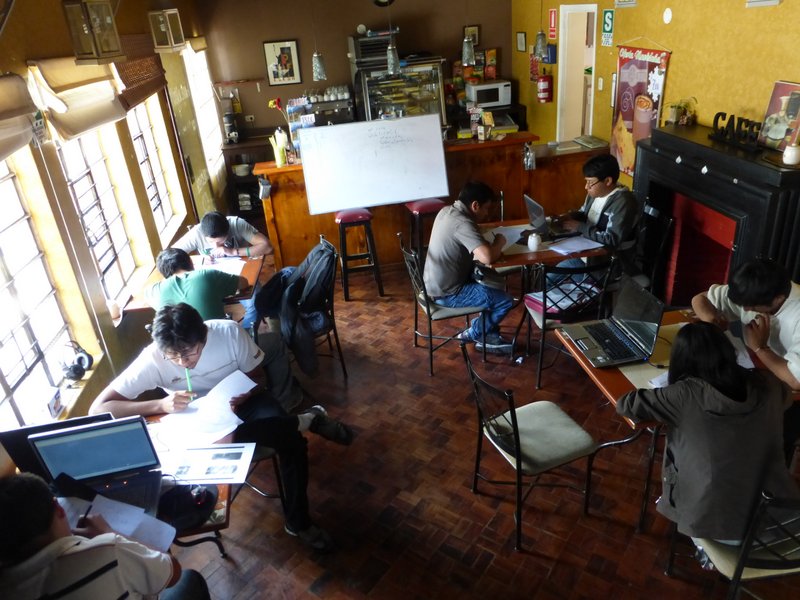
Students at a local cafe, doing an exam to apply for a Drupal summer intensive
The Future
The most exciting development is that we’re starting on a community project that will involve lots of students. It’s a web platform for university students where they can share their experience, study notes etc online. We’re hoping that this will be used in universities across Latin America. We won a small innovation grant to get started. More about that some other time.
I’d love to hear your ideas. What could I do better? Ideas that could help us build a community here in Arequipa, Peru - especially with limited time and resources?
| Attachment | Size |
|---|---|
| Drupal Class at UNSA university | 122.08 KB |
| Students taking an exam at a Cafe | 117.12 KB |


Comments
Thanks a lot for sharing
Thanks a lot for sharing David
Building community on or off line can be very difficult. It sounds like you have been doing a lot of great work
From my own experience building other types of communities, maybe some ideas to think about:
trying to involve non-for-profits that benefit from Drupal and sharing some case studies from non-for-profit organisations in other countries
tying to find sponsors in the private sector to offer different things at the meetups like an open bar, food, etc
definitely try to share the load so that you done burn out as it sounds like you have been doing a lot
definitely a story that maybe some local or national media might be interested to tell if you can use a good angle like the increase in the use of open source solutions, etc
Good luck and keep on telling us how things progress
Buena suerte!
Raúl
Raul Caceres
www.simsolutions.net.au
Thank you!
Thanks for your ideas Raul...
We're fortunately to have a Cafe that's always willing to give us a venue. There are three (very) small Drupal shops in town & I'll see if they'd be willing to sponsors food or drinks. They are directly benefiting - two of the three have hired students from the Drupal class.
You're right about sharing the load. I need to find someone else who will help organise events - maybe even take some classes. I only do the Drupal classes at the uni every second semester - it's too much work otherwise.
I've tossed around the idea of getting the local media involved. It would help to raise the profile of Drupal and get more students interested in doing the class. One big win I didn't mention is that now one of the university's websites is in Drupal - http://www.episunsa.edu.pe/web/ . That means that the university has a vested interested in having Drupal students and hopefully that means slowly more Drupal university sites.
You mentioned trying to involve not-for-profits that benefit from Drupal. As far as I know we don't have any not-for-profits who use Drupal in our city yet. We do have several commercial companies that have Drupal sites.
Saludos
David
Cool
Sounds like you're doing a great job David. Thanks for sharing this story.
Inspiring!
What a great story!
This must have taken a lot of your time.
Apart from this small innovation grant, were you and colleagues sponsored or funded in any way? How did you balance work that pays the bills with your charity/community work?
Rik
Paying the bills
Thanks Rik! Good question. It started as just something I did in my spare time and didn't affect my main work but things slowly have changed a little.
I work as a volunteer with a Peruvian Christian university student movement called AGEUP. We can pay the bills thanks to our our church in Australia, family and friends who support us financially. A mission organisation facilitate this.
Teaching the Drupal class was really hard - working out a curriculum and preparing for 4 hours of class hours per week. I lost a lot of sleep. After this class I had some students who were keen to work and we took on some mission projects. One involved a converting a 700 page Joomla site to Drupal (MisionesSIM) and several other sites. Once this began, the Drupal work has been a bit more integrated with everything we do. This semester I'm doing just a 2 hours of class time per week so I can focus more on our project.
I'd love to talk about the innovation grant and the project but I think there's too much in my head and I'm scared to begin. The grant has helped to fund one grad full-time and some other expenses till we launch in Feb 2014. Will share more soon.
David
It is a great work that he does...
It is a great work that he does, I feel we are asleep in giving strength to work professionally with Drupal. Thanks for your work.
Myself included, need more time than we have not. Here in PERU unfortunately we constantly run into many walls especially economic, we must encourage.
Some suggestions:
* Identify local-professional contact points where we can go and implement common projects.
* Promote projects management on Drupal.
* Promote best practices, keep a list of these practices in various environments (VPS, Shared Hosting, Cloud on).
* Continue to promote knowledge sharing among all.
In my case, I want to raise again firmly my personal project and to be the voice and hands of all support professional development of any initiative Open Source in general.
Sorry my bad english...
regards,
Juan Siesquen R.
Force IT Solutions / LPIC-1
@jsiesquen
Profile: http://cvgram.me/jsiesquen