
We've just released the first (working) version of the Translation Management module.
The purpose of this module is to create a systematic process for translating large Drupal sites.
Highlights
- Dedicated Translator Role - translators have language pairs and can translate only in them.
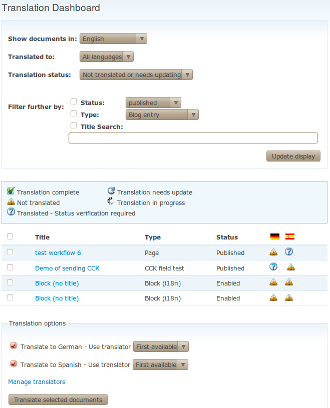
- One Translation Dashboard page - shows everything that needs translation including nodes, blocks, CCK, strings and what-have-you.
- Translation Jobs Queue for translators - each translator sees the jobs waiting for him/her.
- Unified Translation Editor - no matter what you're translating, you're always doing it from the same page.
Who is Translating?
Right now, translators can be Drupal users. You can give Translator privileges to existing users or create new users for translators.
In the very near future, we're also working on an API for interfacing to translation services. This API would be open and any translation service is invited to create a connector for itself.
The Module Itself
The module is now released and working. You can get it from:
http://drupal.org/project/translation_management
There's no official guide yet, but this blog post should be a good place to start:
http://drupal-translation.com/content/translation-management-alive
This kind of thing is an enabling feature for using Drupal on enterprise Drupal sites. Managing translation work can be a huge task and we hope that this helps.
Feedback? Ideas? Comments?
Comments
The logic behind the translator role
I've installed the module and it seems very promsing. The only thing is that, to me "translators have language pairs and can translate only in them" seems a bit weird, since some translators might master many languages.
In my case after I've set my user to be able to translate from Finnish to Swedish. Then I try to set Finnish -> English to the same user in
admin/content/translation-management/manage-translator
, after which I get: "All of the users are already translators. Go to user list". This would basically mean that if I have any multilingual translators they would need multiple user profiles on one site in order to get the job done. Would the possibility of having multiple languages per user be perhaps better?
You can add more languages
Normally, translators translate into one language, so this is how the GUI is built.
Once you've added the 1st language for a translator, go back to the 'Manage translator' page. Click on the name of the translator to edit.
Now, you have a full list of source and destination languages. You can select the checkboxes between any language you choose.
Edit translator
When I'm in the edit translator page, and I have the checkbox for one language "From..." checked (let's say From English), I can check all the "to..." languages I want from that language (to Swedish, to Spanish,...), but I cannot check any other "From" language checkbox (From Swedish,...). Or rather, I can check them, but when I press save, the checkboxes remain unchecked.
I don't know if this is a bug or I'm doing something wrong.
I appreciate any help! Thanks!
This is a bug and it will be
airun
This is a bug and it will be fixed in the next release.
Thanks!
Found it and it works perfectly.
Translation Que URL
Hi - I'm developing a site that uses this module, but we don't have email set up yet. So I cannot get the email once a piece of content is assigned to me as a translator. I am trying to test things from the Translator perspective. Could someone please provide me with the URL I should go to in order to see the Translator Que? I thought I would see something once I logged into that account. But I don't.
Thanks!
Ah HA!
I found it - it's simply /translator. :)