Importing Existing Websites into Aegir
Aegir 0.4 Notes
No time to revise whole page...much of the stuff below the "--Older Stuff--" is probably still valid. See the process here: http://drupal.org/node/908524#comment-3472038
-------- Older Stuff ---------
Moving existing websites to be hosted under Aegir is very straightforward, and will then give you the full power of Aegir for future upgrades and so on - just as if the site had been created on Aegir in the first place.
Read moreCreating A Platform in Aegir
Last updated by clemens.tolboom on Sat, 2010-09-04 13:10
A platform is a codebase on which Aegir can deploy your websites - it could be Drupal 6.15, Drupal 5.21, Pressflow, Prosepoint, Acquia Drupal, or Open Atrium. At the least, think of a platform as a copy of Drupal core, against which your sites are provisioned upon. Typically what distinguishes a Platform is its custom install profile (such as the case of OpenAtrium, ManagingNews and so on) and custom extra modules, libraries or themes.
When Aegir has these codebases, or platforms, it allows you to easily setup new sites and upgrade existing sites by 'migrating' them to a new platform.
Read moreAegir FAQ
The Aegir Project has moved.
This Drupal group is no longer actively used.
To get involved and learn more about Aegir, you should go to our community site,
which also contains our official documentation section and the official discussion group.
Comprehensive Instructions to setup a LAMP stack plus Aegir 0.3RC1
As a weekend project I setup Aegir 0.3RC1 on a VPS (see the bottom of this page for links to VPS hosts).
I have to take my hat off to Adrian and the rest of the Aegir team - it's amazing. So I wanted to write up the installation procedure in a way that makes it as easy as possible for others to try out...
Setup the LAMP stack
The best route to setup the stack in the first place is to use an appliance from Turnkey Linux - they offer a LAMP stack which has much of the configuration done.
Download the appliance here: http://www.turnkeylinux.org/appliances/lamp
Using Aegir
(i'm trying to make some documentation of using drush & aegir, please give me some feedback)
Start with watching the screencasts:
Installing Aegir from scratch & Aegir in action
Migrating sites to aegir
- aegir doesn't import sites/default
- mv sites/default sites/actualdomain.com
- leave a symlink to sites/default in place

Aegir from scratch - Installing Aegir 0.2 RC1 screencast
Just to give this some more visibility, I have made a very thorough screencast showing how to install the newest release.
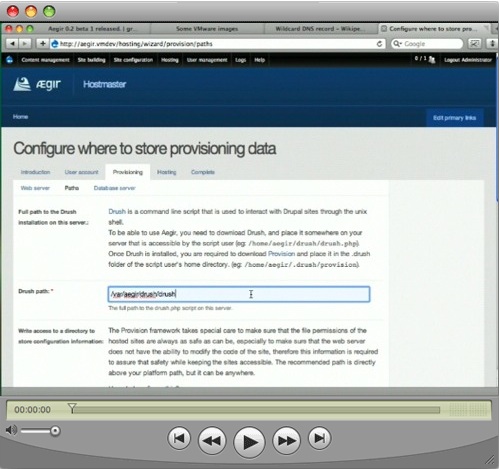
Bug submission guidelines
Somehow a bug or two may have slipped into Aegir. Reporting bugs is a great way to contribute to Aegir and help all of us shape Aegir into the Drupal management system we want and need. Mis-reporting bugs or duplicating reports, however, can be a distraction to the development team and waste precious resources. So, help out by following these guidelines for reporting bugs.
Before reporting a bug:
- Review these tips on configuring Aegir, drush, Apache and more.
- Search
groups.drupal.orgto see if your problem or question has already been addressed. - Look at the current issues for all of the Aegir-related queues to see if the bug has already been reported.
Red Hat EL 5.3 Install notes
Below are some notes of my install process on a Red Hat Enterprise Linux 5.3 System. I installed a 0.2 Head version including a (pre-bug) version of drush. (Mid March 2009) These notes were not verified (yet) and commands were reshuffled somewhat.
UPDATE: Instructions below will not work with Aegir 0.3 and higher. Drush provision now has more dependencies on the full php 5.2.x so just adding json to the native php 5.1.6 will no longer be sufficient.
Cheers,
Paul Krischer / "SqyD"
first@lastname.nl

Updated install and upgrade documentation for 0.2
I have done a quick spike at building proper install and upgrade instructions for the current HEAD, which will soon become 0.2. Those are simple text files now part of the hostmaster install profile named (unsurprisingly) INSTALL.txt and UPGRADE.txt.
Read more